SelfPublishHQ Review: Self-Publish Your First Book in the Right Order
There is no shortage of advice on how to write a book with AI and publish it on Amazon. There is a shortage of order: what to do first, what to do next, and what can wait until Book 3. SelfPublishHQ is that running order. Seven stages, 19 guides, every one built on a real 102,000-word novel the author wrote with AI and published on KDP, mistakes left in. $27 one-time, $17 this week, plus my eight bonuses: three tools for the counting, testing and scheduling the guides leave to you, four guides for what comes after Publish, and an AI skill that keeps every book on one dashboard.
Short version: this is the most honest self-publishing product I have reviewed. No income screenshots, sourced numbers on what authors really earn, KDP rules checked against Amazon’s help pages in October 2026, and one real book running through all 19 guides. It is PDFs, not software, and it works with ChatGPT, Claude, Gemini or no AI at all. The guides tell you what to count, test and schedule by hand. That is the part my bonus tools take over, and four guides cover what comes after Publish.
What is inside SelfPublishHQ
I bought it and read all 19 guides and the calculator guide from inside the members area. Two courses: the Core 5 (orientation, decision, writing) and the Entry Package with the 14 next-step guides. Each guide is 6 to 22 pages, ends with “next on your roadmap”, and uses Paladin 404 as the worked example: a 32-chapter GameLit mystery, 102,000 words, written with AI, on Amazon under the pen name blogbum.
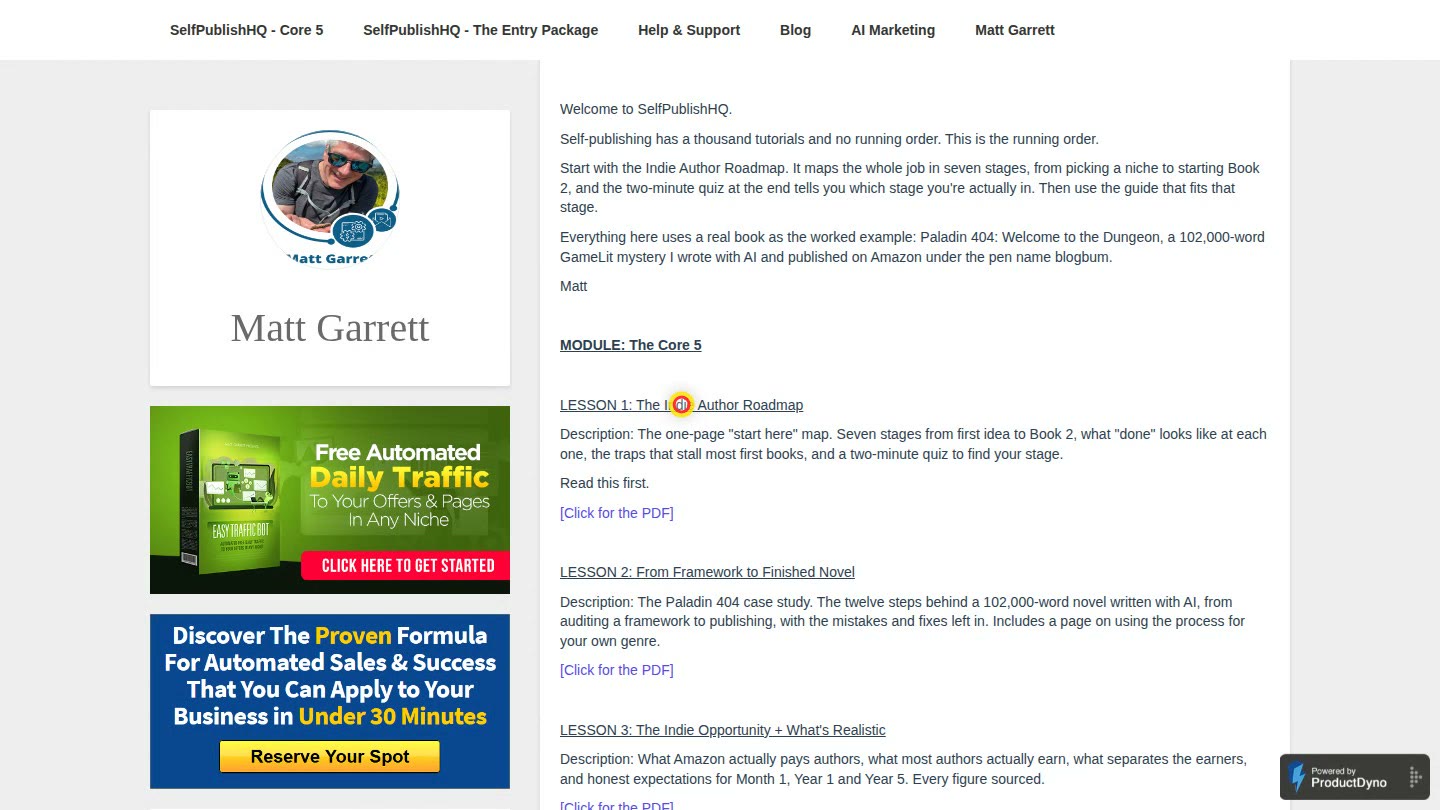
The Core 5 inside the members area: the Roadmap, the case study, the realistic numbers, the Niche Finder and the Prompt Pack.
- Stage 1, Start: the Core 5. The Roadmap maps the seven stages, what “done” looks like at each, the trap that stalls each one, an example pace (a first novel in about four to six months around a job) and the find-your-stage quiz. The case study walks the twelve steps behind Paladin 404. The Opportunity guide gives the numbers nobody puts on a sales page: what Amazon pays, what most authors earn, what Month 1, Year 1 and Year 5 look like.
- Stage 2 and 3, Decide and Write. Fifty sub-genres readers binge, each with its reader promise and a built-in series angle, a 10-minute Amazon check and a 20-minute decision drill. Then 30 copy-paste prompts in seven toolkits with a Book Brief you fill in once, a Series Bible template in eight sections so Book 3 never contradicts Book 1, and a sprint checklist with a five-step chapter loop and a 30-day calendar.
- Stage 4, Polish: the AI-Tell Polish Pass. Seven passes in a fixed order, the three deadly tells with before-and-after fixes, six sentence sweeps and a counting prompt. The real findings from the Paladin 404 whole-book edit: “looked, stared, glanced, watched” 549 times, “Alf looked at her.” standing alone as a paragraph 21 times, 87 “Not…” fragments, 12 of 32 chapters ending in the same shape. Measured, then decided.
- Stage 5, Package. Six title formulas, a genre cover dialect table, a one-page cover brief, the four quality gates (the thumbnail test at about 160 pixels first), KDP’s ebook cover specs. Ten blurb templates with the hook-first rule and eight A+ layouts. A pen name and platform kit, an author site built with AI in an afternoon, and a short-story reader magnet with a three-email welcome sequence.
- Stage 6, Launch. The review rules that keep reviews live (including the $50-in-12-months reviewer eligibility that silently kills ARC reviews), a 14-day ARC plan for 15 to 25 readers, four copy-paste emails. Then the launch calendar from T-30 to T+14, how free days and Countdown Deals really work (checked against KDP’s help pages), promo sites in tiers, templates A to G and a dashboard.
- Stage 7, Grow. The Series Economics Calculator shows what one reader is worth across a series and why Book 1 can be cheap or free. The audiobook guide covers KDP Virtual Voice and when a human narrator pays. The Book 2 Fast-Track is a seven-day restart. The Tool Stack Map lists a zero-cost starter stack and marks the vendor’s own tools as his.
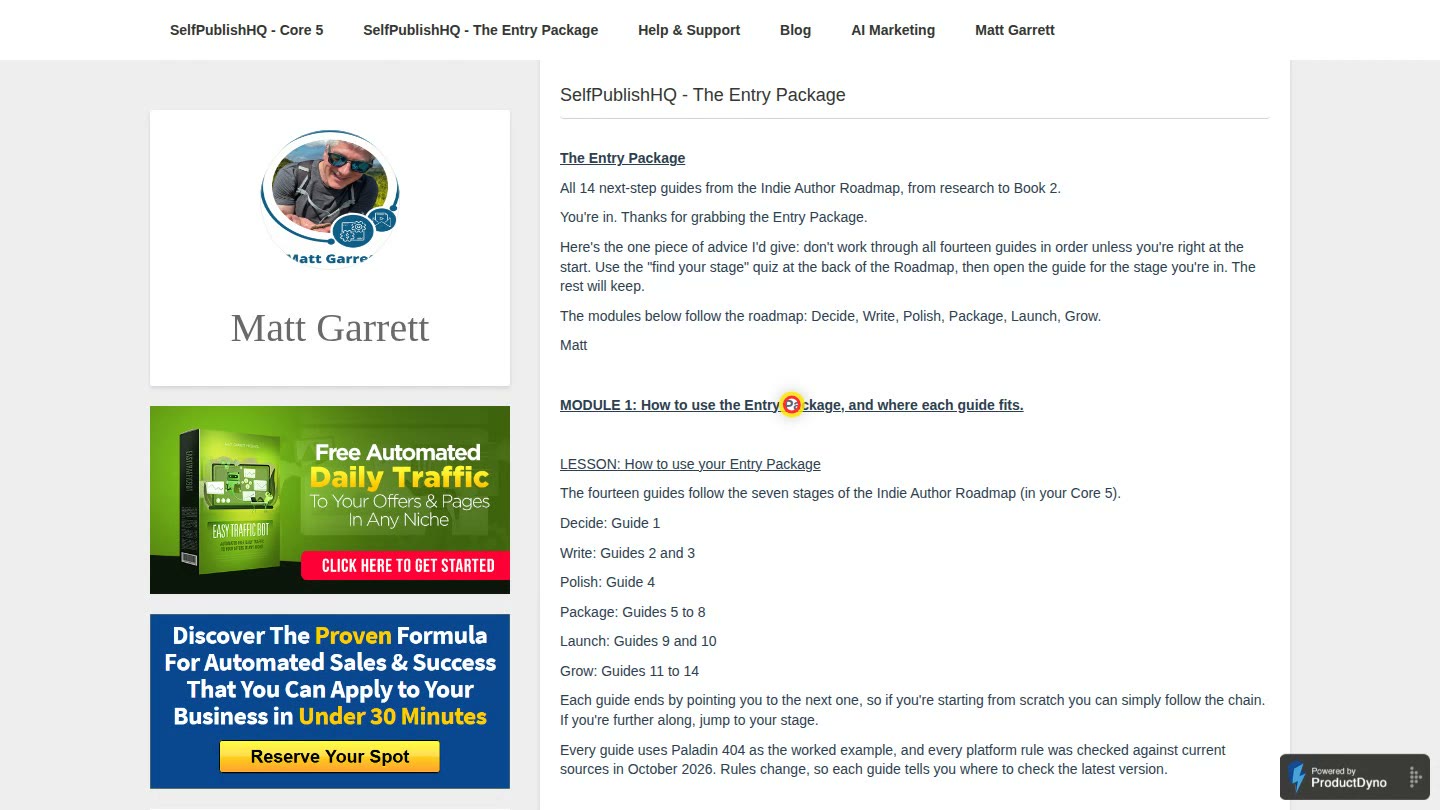
The Entry Package: 14 guides in roadmap order, each with a one-line “use it when”.
Where first books stall after the guide is read (and what I did about it)
- The polish pass never ends. Guide 4 says to count your tics with a prompt and your word processor’s search, and warns that long manuscripts need splitting into chunks. My Tell Counter runs every count on the whole book in one go, offline.
- The cover is judged on a big screen. Guide 5 says to shrink it to about 160 pixels and put it next to the top 20 in your sub-genre. My Shelf Test does exactly that, with squint mode, the KDP spec check and the blurb fold.
- The launch is improvised. Guides 9 and 10 give a 14-day ARC plan and a T-30 to T+14 calendar as tables. My Launch Calendar Builder puts both on real dates, checks the KDP Select rules against them, and exports to your calendar.
My SelfPublishHQ bonuses — for every buyer
Three tools built new for this launch after reading all 19 guides, plus four guides from my library added on November 6 and an AI skill added on November 9. Everyone who gets SelfPublishHQ through this page gets all eight in one bonus area.
The First-Book Finishing Kit — $506 total value
SelfPublishHQ gives you the running order. Three tools do the counting, the testing and the dating that the guides tell you to do by hand; four guides (added November 6) cover the KDP rules, the four weeks after Publish, the AI-copy polish and the pipeline for Book 2; an AI skill (added November 9) keeps every book you write on one dashboard. The tools run offline in your browser: no account, no key, nothing uploaded.
The Whole-Book Tell Counter — $67 value
Offline web app, single HTML file, built for this launch
The AI-Tell Polish Pass tells you to count your tics with a prompt and your word processor’s search, chunk by chunk. Drop in the whole manuscript (.docx, .txt or .md) and the counter runs every search at once: meta-leaks, the six sentence sweeps with every hit in context, gaze beats per 1,000 words, sentence openings, “Not…” fragments, reflex lists of three, dialogue tags, repeated phrases, one-sentence paragraphs that recur, words per chapter and chapter-ending shapes. Your numbers sit next to the Paladin 404 benchmark. Export the report as Markdown or the hits as CSV.

The Amazon Shelf Test — $47 value
Offline web app, single HTML file, built for this launch
The Cover & Title guide says a cover is judged at about 160 pixels, in a list of competitors, in about a second. Upload a candidate and see it at 160, 100 and 60 pixels inside a shelf of covers in your genre’s dialect, or your own competitor screenshots, with squint and grayscale modes and the KDP spec check (size, ratio, file weight, light edges). Type title, subtitle, series and author for the search-result card and the KDP title checks. Paste the blurb for the desktop and phone fold, the 200-word count and the five-part anatomy. Tick the four gates, download the scorecard.
The Launch Calendar Builder — $47 value
Offline web app, single HTML file, built for this launch
The ARC Playbook has a 14-day plan, the Launch Playbook a T-30 to T+14 calendar and the KDP Select rules. Enter your launch date and route (full price, free days, Countdown Deal, price pulse) and every task from both playbooks lands on a real date, with the Select rules checked against your dates: the 5 free days per term, the 30 days in Select before a Countdown Deal, the unchanged list price, one promotion type per enrolment. Tick tasks off, print the plan, copy it as text or export it as an .ics file for Google Calendar, Outlook or Apple Calendar. The launch dashboard saves in your browser.
The KDP Account Safety Checklist — $67 value
PDF guide, added November 6
The KDP rules that end accounts, each one sourced to the help page it comes from, folklore separated out. A pre-publish safety check for title, cover, description, keywords, categories and interior; Amazon’s exact AI-GENERATED vs AI-ASSISTED definitions with a worked-example table (AI cover art must be declared); the disappointing-content list and where PLR sits; volume limits; what to do when the removal or suspension email arrives, with an appeal template and the evidence folder to keep beforehand. Ends with a twelve-point pre-submit card.
The First 30 Days — $67 value
PDF guide, added November 6
The four weeks after you hit Publish, as a checking layer. Day 0 publish-day checklist, Days 1–3 verification (the phone read, Look Inside, categories landing, your own seven keywords, the thumbnail test), Days 4–10 reviews without getting the account flagged, Days 11–17 the first data read and the keyword swap, Days 18–24 the price ladder and the royalty cliff, Days 25–30 the first ad test, Day 30 keep / fix / kill with a seven-step diagnostic tree for when nothing sold.
The AI De-Genericizer — $77 value
PDF prompt guide, added November 6
Twelve constraint prompts that take the average out of AI-written copy (Persona Injection, Specificity Pass, Tell Hunt, Verb Pass, Delete Pass, One-Reader Rewrite, Objection Insert, Rhythm Break, Proof Swap, Opening Line Forge, Read-Aloud Test, Consistency Sweep), the six-line brief that prevents most of it, a which-prompts-when table and the field-by-field run on a book listing. Every prompt forbids invented statistics, prices, results or testimonials. Pairs with guide 4, the Polish Pass.
The 90-Day Publishing Sprint Tracker — $67 value
Offline web app, single HTML file, added November 6
The Series Sprint Checklist plans Book 2; this tracks it. Nine stages per title (idea, demand checked, interior, cover, listing built, published, verified live, first review, Day-30 decision), click-to-tick, sortable columns, per-title notes, CSV import and export, and the two counters nobody watches: live but unverified, and stalled 21 days or more. Data stays in your browser.
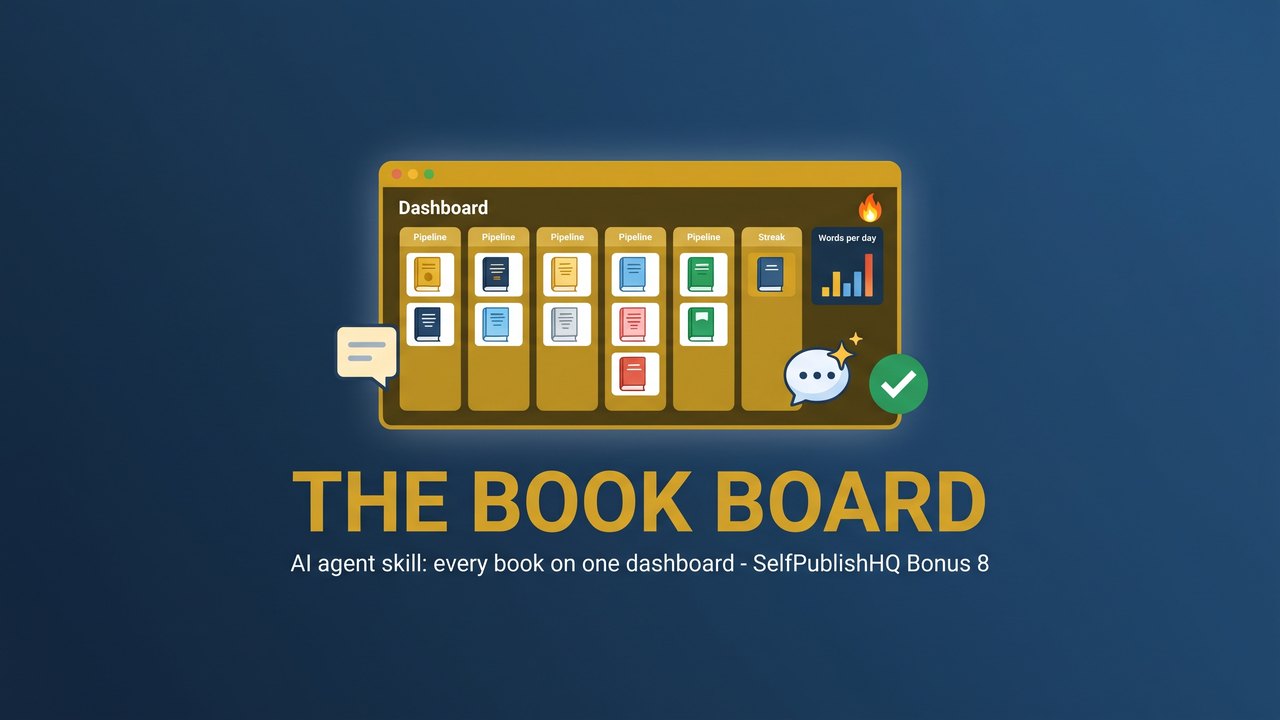
The Book Board — $67 value
AI agent skill for Claude, ChatGPT or Codex, added November 9
One dashboard file for every book you are working on, series, stand-alones and non-fiction alike. Each book sits on the seven SelfPublishHQ stages with the three “done when” checks of its current stage, the trap of that stage and the guide or bonus that helps. Words per day against your goal, your streak, launch countdowns, notes, your Tell Counter numbers next to the last run, and a red flag on any book with no activity for 21 days. Tell your AI what you did (“1,800 words today, the blurb is done”) and the board updates, or tick boxes on the page and paste the update block into the chat. Works in Claude Code, Claude.ai with code execution, ChatGPT with the code tool and Codex. All data stays in one file on your computer.
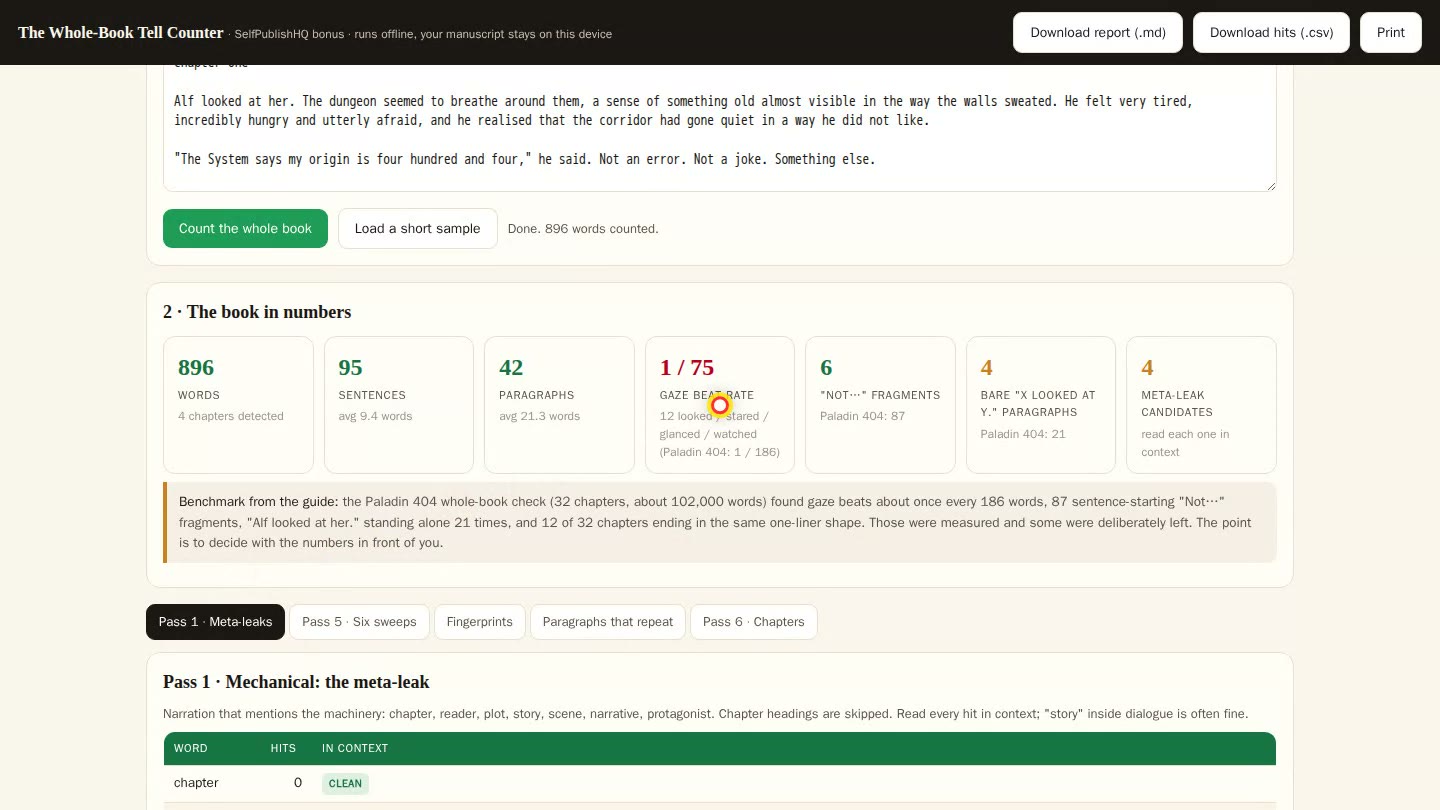
The Tell Counter on a manuscript: the headline numbers next to the Paladin 404 benchmark, then every sweep with hits in context.
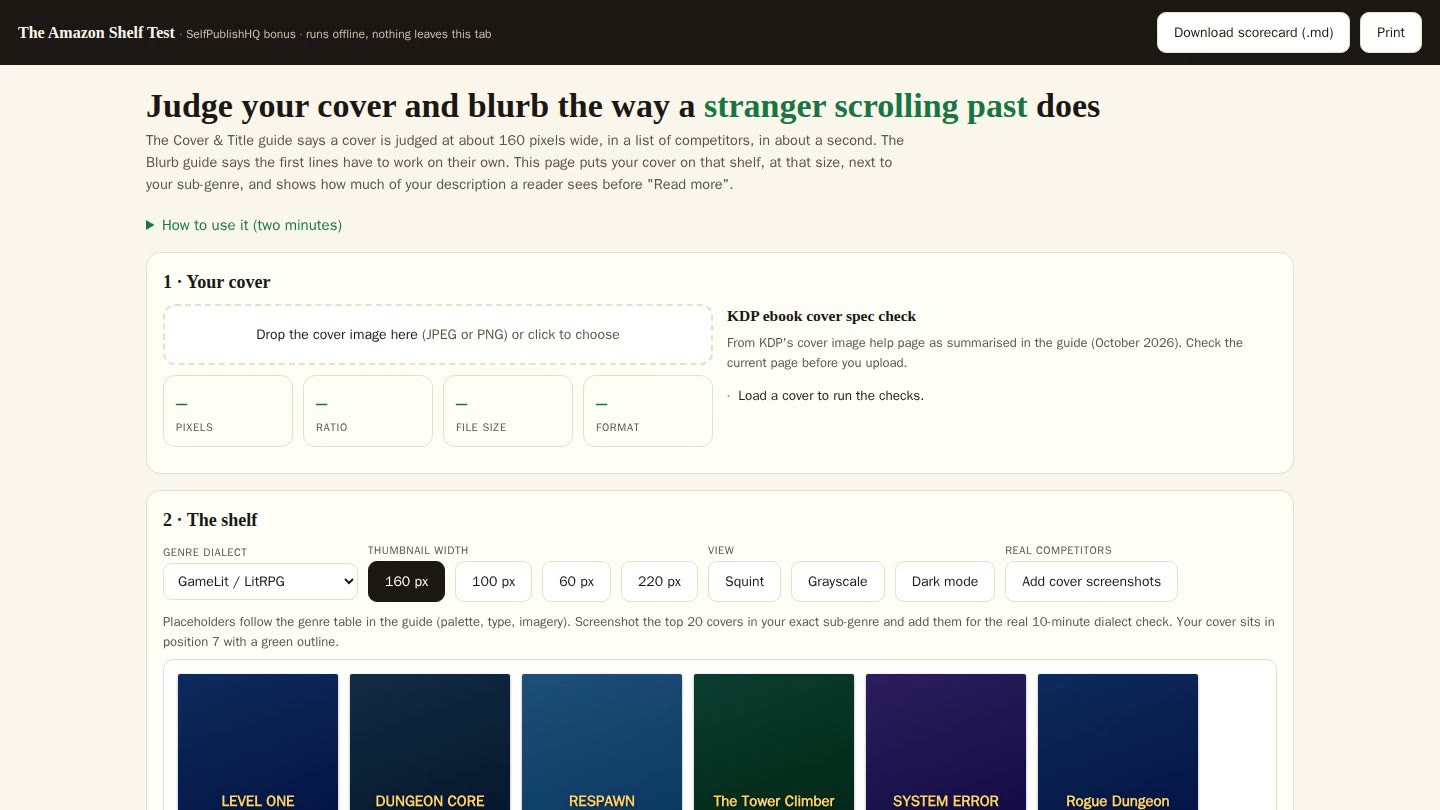
The Shelf Test: your cover at thumbnail size inside your genre’s shelf, squint mode on.
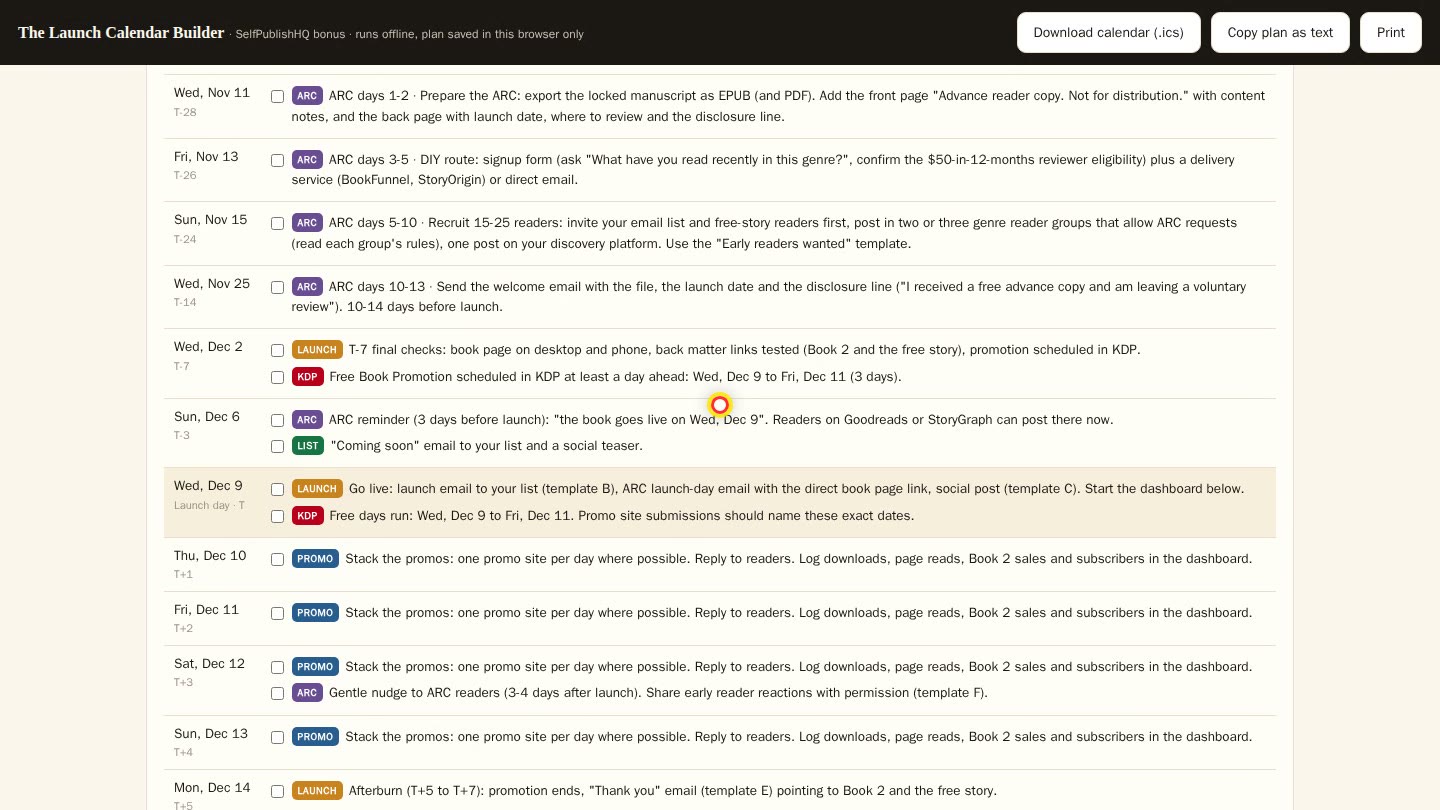
The Launch Calendar Builder: every task from both playbooks on a date, the rule checks above.
Added November 6: the video mentions more bonuses during launch week. They are in: The KDP Account Safety Checklist, The First 30 Days, The AI De-Genericizer and The 90-Day Publishing Sprint Tracker, in the same bonus area as the three tools. Buyers from before November 6 have them already.
Added November 9: The Book Board, an AI skill that keeps every book you write on one dashboard, stage by stage. Every buyer gets it in the same bonus area, earlier buyers included.
SelfPublishHQ price and upgrades
The front end is $27, one payment. During launch week the coupon HQVIP is applied at checkout automatically and you pay $17, until Monday November 9, 11:59 PM EST. The upgrades are offered after checkout and are optional; the front end works by itself.
| Option | What it adds | Price |
|---|---|---|
| SelfPublishHQ: The Indie Author Roadmap | The Core 5 + all 14 next-step guides (19 guides, 20 PDFs) + the interactive Series Economics Calculator, in a members area. Vendor’s stack value $483. | $27 ($17 with HQVIP) |
| Book Cover Creator (order bump) | Cover, mockup and promo visual generator (BookCover Studio AI) | $14.95 |
| FindYourReaders: Reader Growth Toolkit | Campaign brief tool, 12 reader growth tools, 4 campaign recipes, newsletter playbook, two worked examples | $37 |
| ShortStoryEngine + Submission Assistant + Buyout | Short stories that introduce new readers to your books, the tool that prepares and tracks submissions (first-year licence), and the lifetime buyout | $17 / $27 / $47 |
| BookPromoPilot + SelfPublishPilot | Broader KDP book promotion | $37 |
| Newsletter Pilot / Short Story Pilot | Browser extensions for author newsletters and for short stories from the browser | $27 each |
Beyond the guides: nothing. The Tool Stack Map shows a zero-cost starter stack (free AI tier, a word processor, Kindle Create, KDP, a free email tier) and says when a paid tool earns its place.
What stands out
- A running order with a finish line at every stage and a quiz to find yours
- One real book as the worked example in all 19 guides, with the mistakes and the fixes
- Honest numbers: sourced survey figures, no income promises anywhere
- Rules checked against KDP’s help pages in October 2026, with where to re-check
- $17 during launch week, one payment, no subscription, 30-day guarantee
Good to know
- It is 19 PDF guides plus one interactive calculator, not software; the vendor says so on the sales page, and I prefer that to a tool that promises a finished manuscript
- The Niche Finder and the case study are fiction-first; non-fiction authors get a flag in each guide for where it differs
- The coupon price is launch week only; after Monday it is $27
How to claim the bonuses
- Get SelfPublishHQ through a button on this page. Every button here carries my affiliate ID, which links your purchase to the bonuses.
- You land on my bonus page right after checkout, with your bonus code on it.
- Paste the code on the claim page with your email. Your bonus area on IM Dominator unlocks straight away with all eight bonuses.
Questions
What is SelfPublishHQ: The Indie Author Roadmap?
A set of 19 PDF guides (20 files) plus an interactive Series Economics Calculator by Matt Garrett, organised as a seven-stage roadmap: Start, Decide, Write, Polish, Package, Launch, Grow. The Core 5 orient you (roadmap, case study, realistic numbers, niche finder, 30-prompt pack) and the 14 next-step guides take you from research to Book 2. Every guide uses a real published novel, Paladin 404, as the worked example.
Is it for fiction or non-fiction?
Both. The worked example is a GameLit novel and the Niche Finder is fiction-focused, but the stages are identical for non-fiction, and every guide flags where non-fiction differs: your promise becomes the reader’s outcome, the series bible becomes a research and claims ledger, the reader magnet is a checklist instead of a short story.
Do I need to write with AI?
No. The prompts are there if you want them (ChatGPT, Claude, Gemini, any of them). The roadmap, drills, templates and checklists work without AI. If you do use AI, the AI-Tell Polish Pass is the guide that makes the draft read like a person wrote it, and my Tell Counter runs its counts for you.
How much does SelfPublishHQ cost?
$27 one-time. During launch week the coupon HQVIP is applied automatically at checkout and the price drops to $17, until 11:59 PM EST on Monday, November 9, 2026. One payment, you keep access, no subscription. The upgrades after checkout are optional: a cover tool bump ($14.95), FindYourReaders ($37), the ShortStoryEngine family ($17 to $47), BookPromoPilot ($37), Newsletter Pilot ($27) and Short Story Pilot ($27).
I am halfway through a book already. Is it still useful?
Yes. The Roadmap ends with a two-minute find-your-stage quiz: the first “no” is your stage. Start there and skip what you have done. Most second-half stalls are in Polish, Package and Launch, and that is where guides 4 to 10 and most of my bonuses sit.
Will I make money with my book?
Nobody honest can promise that, and the vendor does not either. One of the Core 5 guides is called “The Indie Opportunity + What’s Realistic” and quotes the sourced numbers, including that 44% of indie authors in a 2025 survey earned $100 a month or less, and what the authors who earn more do differently: a series, a list, more books.
What is the guarantee?
30 days. Read the guides, use them, and if they are not useful to you, open a ticket at the vendor’s support desk within 30 days of purchase for a full refund. Those are the vendor’s terms.
How do I claim your bonuses?
Get SelfPublishHQ through a button on this page. After checkout you land on my bonus page with your bonus code. Paste it on the IM Dominator claim page with your email and your bonus area unlocks straight away, all eight bonuses in one place.
Bottom line
SelfPublishHQ is worth it if you have a book in you, or half of one in a folder, and you want the steps in order instead of another hundred tutorials. For $17 this week, with my Tell Counter for the polish, the Shelf Test for the cover and the Launch Calendar for the launch, it is the cheapest complete path from blank page to Book 2 I have seen.